Sunday, January 23, 2011

Notes from a frozen river # 2

Slushy ice in the still-not-completely-frozen Musconetcong River, this despite single-digit nighttime temperatures. Tonight is supposed to be minus 8! I watched a deer wade across it (apparently comfortable) yesterday.

Fox tracks and pee at a rose-bush that doubles as a scent post.
 
A mouse highway between two rose-bush clumps.


Barberry berries are still around. Something must eat these because it spreads all over. But they can't be very tasty if they are still around at this date.

A crew-cut of spice bush sprouts, munched down by deer. This (plus all the thorny invasives dominating the shrub layer) is a sure sign of over-abundant deer. 

This hermit thrush was hopping around the cliff-side and eating multi-flora rose hips. It was a good bird morning. Also seen: winter wren, yellow-bellied sapsucker, field sparrow, pileated woodpecker, brown creeper.

Thursday, January 20, 2011

New threatened bugs in NJ

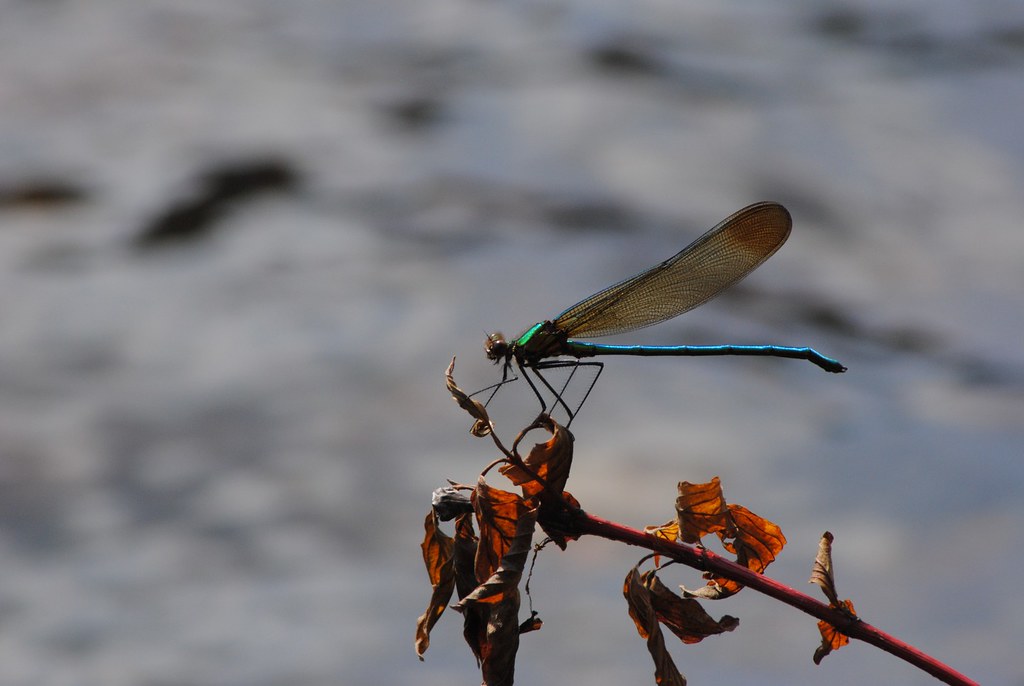
A Superb Jewelwing (Calopteryx amata), a damselfly newly added to the NJ Threatened species list (photo by Mike Ostrowski).


Right after I wrote complaining that NJ doesn't pay enough attention to insect conservation I learned that NJ DEP will soon be adding 7 dragonflies to the threatened and endangered species list, and a whole bunch of invertebrates (lots of dragonflies, a butterfly, and a mussel) to the "special concern" list. (Incidentally, six birds will also be added to the list: American kestrel [T], cattle egret [T], horned lark [T], black rail [E], golden-winged warbler [E], and red knot [E].)

There is also a newish guide to the Dragonflies of NJ out by Conserve Wildlife Foundation, and a nice website on the same subject. OK, so we've covered butterflies, dragonflies, and mussels...when are they going to tackle beetles, flies and wasps?

The 7 new T & E dragonflies are:


Banner Clubtail - Gomphus apomyius (T)
Brook Snaketail - Ophiogomphus aspersus (T)
Harpoon Clubtail - Gomphus descriptus (T)
Kennedy’s Emerald - Somatochlora kennedyi (T)
Robust Baskettail - Epitheca spinosa (T)
Superb Jewelwing - Calopteryx amata (T)
Gray Petaltail - Tachopteryx thoreyi (E)


Good Books


Wednesday, January 19, 2011

In praise of a bug guide

Red-headed Pine Sawfly larvae (Neodiprion lecontei) devouring a new pitch pine shoot in the NJ Pine Barrens.

Proof that the internet is magic: I submitted this photo to BugGuide.net yesterday morning, and by afternoon I knew that these creatures were the larvae of the Red-Headed Pine Sawfly (Neodiprion lecontei). Sawflies aren't flies at all, but a relative of the bees and wasps.

BugGuide.net also stores and displays the geographic location of each bug species it identifies, making it like a virtual museum collection. That makes it the only source of general NJ insect and spider distribution info that I know of. I know there are butterfly, moth, and dragonfly lists, but does an "Insects of NJ" list even exist? How many species are there? What counties are they found in? It seems to me that NJ DEP and other organizations should be making atlases of all types of organisms...mosses...protists...fungi and lichens... why isn't there an unlimited source of funding for biodiversity conservation?!!??

Tuesday, January 18, 2011

Notes from a frozen river

The (partially) frozen Musconetcong, a nationally recognized 
"Wild and Scenic River."

There is a whole world going on in an around the icy river these days, completely undeterred by the ice and snow. The snow actually helped to reveal creatures that I hadn't been aware of, like the river otter and a cave-dwelling red fox...

Otter scat and tracks along the riverbank.
Otter scat detail: it's filled with fish scales.
The otters' "snow slide."
A tiny cave in a riverside cliff with fox tracks leading into it.

A guy named Steve who was out walking by the river (the first self-described "tracker" I've ever chanced upon in the woods) kindly pointed me to this black duck carcass. I regularly see flocks of 10-15 black ducks on the river (along with dozens of Canada geese and the occasional common merganser), but never their ubiquitous cousin the mallard...

The remains of an American black duck found on iced-over eddy. 
Possibly killed by the fox that left prints all around it.
Close up of the iridescent patch on the black duck's wing.
A muskrat swimming comfortably in the icy waters.

Monday, January 17, 2011

Notable Hermits: Estwick Evans


“I wished to acquire the simplicity, native feelings, and virtues of savage life; to divest myself of the factitious habits, prejudices and imperfections of civilization; to become a citizen of the world; and to find, amidst the solitude and grandeur of the western wilds, more correct views of human nature and of the true interests of man." – Estwick Evans (1787-1866) 

Wow, what a hermit. I found this on Stephen Bales' "nature calling" blog. Stephan (the author of Ghost Birds, about the Ivory Billed Woodpecker) describes him as:

"An attorney who walked, in the dead of an extreme winter, from his home in New Hampshire to Detroit dressed in buffalo skins. He wanted to experience the wilderness first hand" 

He wrote a book about his journey with the nice title "Evan's Pedestrious Tour of 4000 miles - 1818."

Sunday, January 16, 2011

Finding a warm place to sleep

The nuthatch hole.

4:22. It seemed a little early for nuthatch bedtime. A full half-hour before sunset, and an hour before real darkness set in. So I decided to sit down on the river ice below the small knothole it had disappeared into and watch. I eyed the hole as steadily as other distractions would allow to see if it was in there for good, or just for a visit.

4:30. A red-bellied woodpecker clucked restlessly from branch to branch, checking out his own potential accommodations
...4:40. A muskrat swam by...


4:44. Having almost forgotten about the sleeping nuthatch, I heard a scuffle overhead. Looking up I see two nuthatches tumbling out of the sky toward me, apparently having fallen straight out of the knothole. An interloper! The two fought it out in a squeaking blur of feathers for a few seconds until one (I imagine it to be the original inhabitant) emerged as the victor and returned to the hole. So that's why he went to bed so early. Possession is nine-tenths of tree-cavity law, or at least pretty important. Essentially, this was prime nuthatch real estate.


The nuthatch hole from a distance.

This made me think about all the other birds that sleep in holes, and how finding a good hole with all that competition can't be easy. In fact, it seems like most of the birds in the woods right now are "cavity nesters," which means they also generally sleep in knotholes, woodpecker holes, hollowed out branch stubs, nooks, birdhouses or whatever enclosed space is available. The titmouse, chickadee, nuthatch,
bluebird, brown creeper, Carolina wren, 6 woodpeckers, and a screech owl: that's a lot of competition!

A titmouse finds shelter in a hollow silver maple branch (not a recent photo).

I would bet that for all of these species, finding a hole at night in winter is a primary concern, almost as big as finding food. Especially when it is 5 degrees and windy out. This is supported by the fact that a good hole seems to be worth fighting for. Remember the nuthatches? And last month the Cape May Bird Observatory posted an account (click and scroll down) of a sapsucker that wouldn't let a poor brown creeper sleep in the same tree nook with him! You would think that it would only make it warmer. (Bluebirds are known to sleep 10 to a box in winter for this very reason.) Maybe the sapsucker just didn't trust that strange-looking, pointy-beaked creeper - a case of speciesism. Or maybe you need just need to be previously acquainted! In the case of the nuthatches, maybe the interloper wasn't a sibling or close relative, but was from another tribe.

Or maybe there just wasn't enough room.

Wednesday, January 12, 2011

fine print: flying squirrel tracks

Two fresh sets of flying squirrel tracks in this morning's snow. They must have glided down from my roof because they start out of nowhere. I've seen them do this same maneuver before: glide from the roof down to the bottom of the oak, scurry up to the upper branches of the oak, and then glide far out over the garden. Surprisingly quick, too.

"I take pleasure in noting the minute things about me...One seldom takes a walk without encountering some of this fine print on nature's page." - John Burroughs