Showing posts with label NJ biodiversity. Show all posts

Monday, July 25, 2011

Bird bug


Hummingbird moth (Hemaris thysbe) drinking nectar from a wild bergamot flower in my garden two days ago (Warren County, NJ).

This insect must have evolved as a "hummingbird mimic"...but why? Even the eye looks like a vertebrate eye, with a dark "pupil" in a brown "iris" (click on bottom picture). The white belly and dark back (known as "bicolored") is a common coloration among birds and other vertebrates. I think the clear patch in the wings makes them look more like the blur of a hummingbird wings. The whole package must be meant to give pause to potential bird-predatator, which presumably couldn't (or at least wouldn't) dine on a fellow bird.

Sunday, July 17, 2011

Ox beetles and other monsters

An Ox Beetle. Taken July 7th in a grassland in Ocean Co., NJ.

This (if my ID books and bugguide.net have steered me right) is an ox beetle (Strategus anteus). I've seen a lot crawling around sandy bare areas of my Ocean County grassland lately. It is one of 5 ox beetles (Strategus sp.) in the US and the only one (at least the only common one) that lives in the Northeast. Bugguide.net shows it going all the way up to Nantucket Island in Massachusetts. Females (which lack horns) lay eggs in rotting wood, where the larvae develop. Male horns probably serve as some sort of courtship or mate-getting ornament, which is amusing to picture!

 Another big beetle (Pasimachus sp., ground beetle family) common in my Ocean Co. grassland. This is a flightless beetle (shell is fused in the middle)! I've found shell remnants below Amercan Kestrel feeding perches. (Photo taken June 22.)

The sandy soils of south Jersey seem to support lots of really big insects. I've seen several other kinds of 1-2 inch beetles (including other dung beetles) crawling around between the grass tufts. Along with the abundance of over-sized grasshoppers, they seem to provide a main source of food for American kestrels (see here and here), and also possibly nighthawks which are common in the Pinelands and apparently eat a lot of beetles...this according to their BNA account and this wonderful Audubon print...

Thursday, June 16, 2011

Goat's rue and other plants I've never heard of


There are about 1861 plant species native to New Jersey (Anderson 1997). So it isn't really surprising that I keep running into new ones. This one (Goat's Rue, a type of pea, photographed June 1 in Lakehurst, Ocean Co., NJ) was particularly strange in its "bicoloredness": yellow and pink. Mustard and ketchup. And it was providing food for an interesting little weevil. Weevils incidentally are the most species-rich family (~60,000) in the most species-rich order of insects (beetles). So I won't attempt to identify it. Anderson (1997) lists 48 native "peas" in NJ (family Fabaceae), not including introduced or extirpated species. Many more peas left to meet.

Another plant I met this spring that I'd never heard of is "Cut-leaved Toothwort." It is in the mustard family, and was growing along the Musconetcong River in Warren County. It seems to be fairly common, but I was excited because it wasn't listed as occuring in Warren County in the great NJ plant-atlas book by Mary Hough. "A discovery!" thought I.


Cut leaved toothwort, photographed April 17 in Musconetcong WMA in Warren County.

Lit Cited
Anderson, K. 1997. A checklist of the plants of New Jersey. Self published. Mount Holly, NJ.

Thursday, January 20, 2011

New threatened bugs in NJ

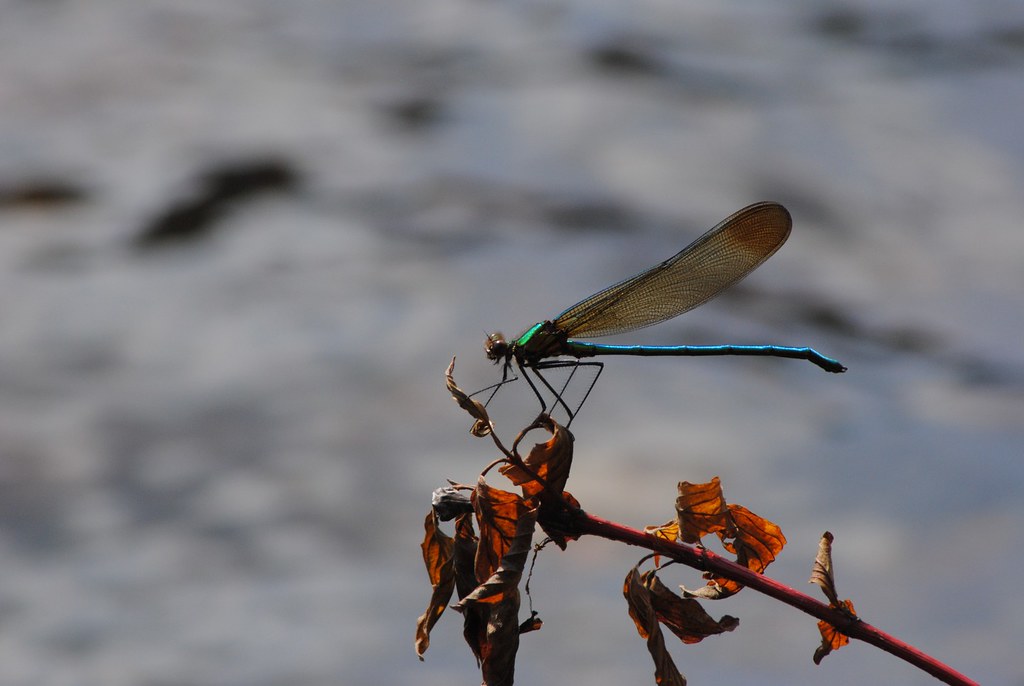
A Superb Jewelwing (Calopteryx amata), a damselfly newly added to the NJ Threatened species list (photo by Mike Ostrowski).


Right after I wrote complaining that NJ doesn't pay enough attention to insect conservation I learned that NJ DEP will soon be adding 7 dragonflies to the threatened and endangered species list, and a whole bunch of invertebrates (lots of dragonflies, a butterfly, and a mussel) to the "special concern" list. (Incidentally, six birds will also be added to the list: American kestrel [T], cattle egret [T], horned lark [T], black rail [E], golden-winged warbler [E], and red knot [E].)

There is also a newish guide to the Dragonflies of NJ out by Conserve Wildlife Foundation, and a nice website on the same subject. OK, so we've covered butterflies, dragonflies, and mussels...when are they going to tackle beetles, flies and wasps?

The 7 new T & E dragonflies are:


Banner Clubtail - Gomphus apomyius (T)
Brook Snaketail - Ophiogomphus aspersus (T)
Harpoon Clubtail - Gomphus descriptus (T)
Kennedy’s Emerald - Somatochlora kennedyi (T)
Robust Baskettail - Epitheca spinosa (T)
Superb Jewelwing - Calopteryx amata (T)
Gray Petaltail - Tachopteryx thoreyi (E)


Good Books


Wednesday, January 19, 2011

In praise of a bug guide

Red-headed Pine Sawfly larvae (Neodiprion lecontei) devouring a new pitch pine shoot in the NJ Pine Barrens.

Proof that the internet is magic: I submitted this photo to BugGuide.net yesterday morning, and by afternoon I knew that these creatures were the larvae of the Red-Headed Pine Sawfly (Neodiprion lecontei). Sawflies aren't flies at all, but a relative of the bees and wasps.

BugGuide.net also stores and displays the geographic location of each bug species it identifies, making it like a virtual museum collection. That makes it the only source of general NJ insect and spider distribution info that I know of. I know there are butterfly, moth, and dragonfly lists, but does an "Insects of NJ" list even exist? How many species are there? What counties are they found in? It seems to me that NJ DEP and other organizations should be making atlases of all types of organisms...mosses...protists...fungi and lichens... why isn't there an unlimited source of funding for biodiversity conservation?!!??