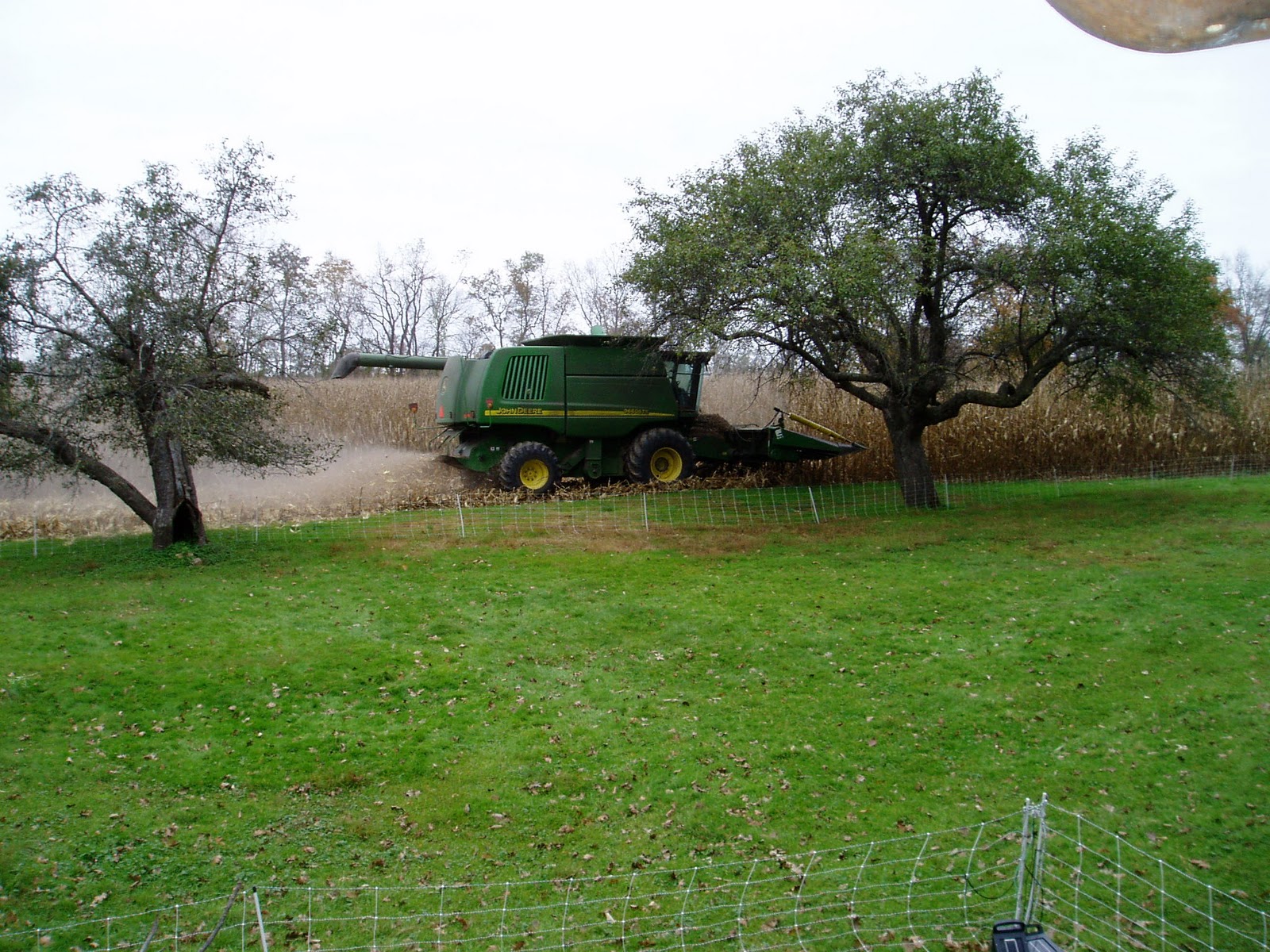
The combine, late October.
Turns out the first swarm of grackles I saw back in September was a fluke. I haven't seen another all month, despite their being plenty of leftover corn in the field. I could easily collect a 55 gallon drum of full corn cobs in a few hours of picking. (I do pick up the occasional cob as supplemental sheep feed.) Last year the megaflocks were a regular occurrence in November and December. But then again we had a harvested sunflower field last year which is essentially a gigantic birdfeeder. Corn isn't as choice to a blackbird, I'd imagine. But it is to snow geese, which should be showing up en masse next month if last year is any guide.
Mixed flock of blackbirds in late fall last year (2010), post-corn-harvest. This year's corn is still green.
I hereby record that the first megaflock* of common grackles this year arrived at my Warren County home in the pre-dusk hours of September 4th. They squeaked and creaked and occupied every ash, hickory, and sycamore branch along a half-kilometer stretch of the Musconetcong River. Then they departed, flying west-ish in the typical (and typically impressive) never-ending-river-of-birds. It would be fascinating to have a map of the wanderings of these bird-herds. Maybe ebird has this in their power?
They apparently wander this way all winter, and farther north than NJ, too. Here is a photo of another megaflock feeding on my lawn when I lived in Orange County, NY (taken December 2009).
Megaflock of grackles in Goshen, Orange County, NY, December 2009.
*I made up the word, but it fits...
 A swarm of thousands of blackbirds take over the sky and woods surrounding a cornfield in Warren County, NJ.
 "The Gleaners" (1857) by Jean-François Millet. Peasant women pick up the left-overs of the wheat harvest. Note the flock of black birds in the background.
The combines have finally come through to harvest the cornfields, and now a plague of blackbirds has descended upon us. Thousands of blackbirds! Grackles, red-wings, cowbirds, and starlings.They blacken the corn stubble with their bodies. They fill up the tree branches. They swarm and stream overhead. The air, fields and woods are a squeaking, creaking, chattering cacophony. It is quite exciting, really.

 Why these four different species feel so comfortable associating together is a puzzle to me. On the ground, they form a pretty even mixture, all climbing over one another for kernels without segregation. And in the air, too, they fly up as a single terrifying superorganism when a red-tailed hawk makes a dive, or the neighborhood feral cat gets too close. A pretty effective strategy, I guess. But I wonder what a red-winged blackbird thinks of the grackle he's rubbing wings with. Not to mention the starlings, who aren't even related, and have only known these new world blackbirds for a mere fraction of a millennium.
 Cowbirds, grackles, and red-wings jostle for position in the old sunflower field.
The flocks aren't singular, but are more like a huge patchwork multiflock. A thousand birds will be in the cornfield, another thousand in the trees, a few hundred down drinking in the creek, and hundreds more streaming in from parts unknown. Each contributes his own chatter and squeak to keep up the ambient din, the creaking soundscape. The patches are glued together by constant streams of individuals moving between them. These are the birds who have had enough of one activity, and are now inclined to partake in another. (Enough corn, time to bathe.)Taking in the spectacle as a whole, it isn't too difficult to imagine the passenger pigeon hordes that must have descended on these same fields only a few hundred years ago. The aftermath.
P.S. my wife just pointed out to me that all (or almost all) of the red-wings and cowbirds are males! Where are all the females?
P.S.S. see related post on snow geese.