Monday, November 1, 2010

The gleaners

A swarm of thousands of blackbirds take over the sky and woods surrounding a cornfield in Warren County, NJ.

"The Gleaners" (1857) by Jean-François Millet. Peasant women pick up the left-overs of the wheat harvest. Note the flock of black birds in the background.

The combines have finally come through to harvest the cornfields, and now a plague of blackbirds has descended upon us. Thousands of blackbirds! Grackles, red-wings, cowbirds, and starlings.

They blacken the corn stubble with their bodies. They fill up the tree branches. They swarm and stream overhead. The air, fields and woods are a squeaking, creaking, chattering cacophony. It is quite exciting, really.


Why these four different species feel so comfortable associating together is a puzzle to me. On the ground, they form a pretty even mixture, all climbing over one another for kernels without segregation. And in the air, too, they fly up as a single terrifying superorganism when a red-tailed hawk makes a dive, or the neighborhood feral cat gets too close. A pretty effective strategy, I guess. But I wonder what a red-winged blackbird thinks of the grackle he's rubbing wings with. Not to mention the starlings, who aren't even related, and have only known these new world blackbirds for a mere fraction of a millennium.

Cowbirds, grackles, and red-wings jostle for position in the old sunflower field.

The flocks aren't singular, but are more like a huge patchwork multiflock. A thousand birds will be in the cornfield, another thousand in the trees, a few hundred down drinking in the creek, and hundreds more streaming in from parts unknown. Each contributes his own chatter and squeak to keep up the ambient din, the creaking soundscape. The patches are glued together by constant streams of individuals moving between them. These are the birds who have had enough of one activity, and are now inclined to partake in another. (Enough corn, time to bathe.)

Taking in the spectacle as a whole, it isn't too difficult to imagine the passenger pigeon hordes that must have descended on these same fields only a few hundred years ago.

The aftermath.

P.S. my wife just pointed out to me that all (or almost all) of the red-wings and cowbirds are males! Where are all the females?

P.S.S. see related post on snow geese.

Wednesday, October 27, 2010

Fog

Steam fog over the Musconetcong River, New Jersey.

Being up at dawn for the last few months, and doing work that requires me to see things (bird surveys), has made me very aware of fog. In fact, I just realized now, after 3 decades, that fog is almost uniquely a creature of the fall.

Why? And why in the morning? And why over water?

For answers, I turned to my favorite source of erudite weather knowledge: USA Today. Actually, it was the first thing that came up in the search engine, but it gave good descriptions of the two main types of fog: steam fog and ground fog.

Steam fog forms over water when the water is warmer than the air (see above). This is the stuff that makes early morning ponds and rivers so picturesque this time of year.

Ground fog is more my nemesis, cloaking vast areas and killing precious visibility. It forms when the ground is colder than the air. It supposedly happens more in the fall because the nights are longer, allowing the ground more time to cool off. This must also be due to the shifting cold and warm fronts of air that happen in fall. (This in turn contributes to the windier weather this time of year...something I've also just noticed). Fog also seems to happen more in certain areas, which must be well known given that there are even highway signs that say "FOG AREA"! Mysteriously, large grasslands seem to be prime fog areas...when there is fog in the forecast, it can be completely clear on the drive to work, but the grassland is engulfed. It is pleasant to breathe in fog, by the way. But hard to see through.

A fog bow, somewhere in south Jersey...

Another great mystery of fog...the "Fog Bow." Just as it sounds, this is a rainbow-shaped thing made entirely out of fog...no colors, just a white tube of cloud. I never would have known, or believed, that they existed until I saw one a few years ago. Also on a big grassland in south Jersey. I googled "fog bow" because that was the only name that I could imagine it having. I was correct, apparently, but I still have no idea (or interest in, really) how it formed. I prefer to leave this mystical fog-beast a mystery.

Friday, September 24, 2010

Why do raptors hate each other?


Large grasslands are good for raptors, especially in September. At the one I work at in Massachusetts, I've seen merlins, kestrels, peregrines, ospreys, Cooper's, red-shoulders, and red-tails all in a single day. And they all seem to hate each other.

Yesterday I saw a peregrine and a Cooper's hawk terrorizing a pair of harriers, which seemed slow and cumbersome in comparison. And they weren't just chasing, but actually making full-speed, talons-forward attacks. The harriers would roll over, talons up, to defend themselves - a common response of larger birds in response to such pestering. But mostly they just seemed to want to be left alone.

It could be a between-species competition thing...or maybe a small bird, large bird thing. But I don't think so. A few years ago (same site, same time of year), I saw a harrier and a peregrine working together, relentlessly attacking a second, perched peregrine (see photos).

Harrier versus peregrine.

Peregrine versus peregrine.

It could be a between-individual competition thing. I'd say it probably is most of the time. A crowded field of hawks, hungry and cranky from migration.

But, intriguingly, it also could be cannibalism of a sort. A common site around the grasslands is merlins (notoriously cranky, even for raptors) swiftly pursuing kestrels in the same "I-want-to-kill-you" way. I've never seen one caught yet, but if I do I won't be surprised.


Harrier wins.

Thursday, September 9, 2010

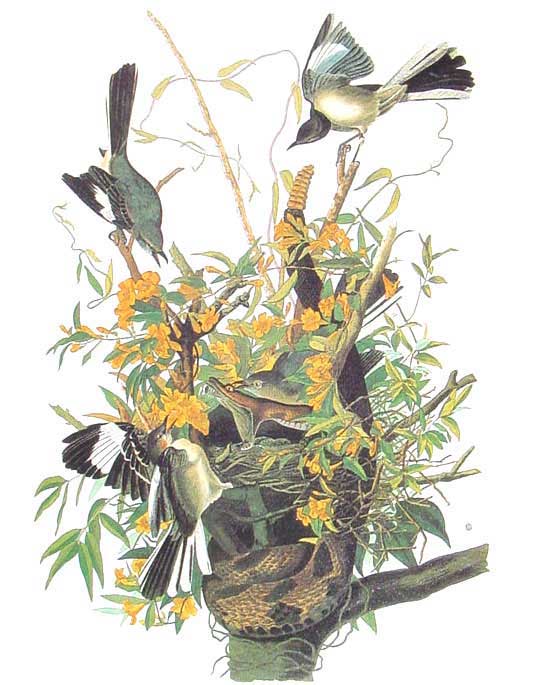
Mockingbird attitude

Audubon print showing typical mockingbird attitude.

A few weeks ago, in Massachusetts, I saw a black rat snake crossing the road with a mockingbird swooping down at it over and over and over again. This seemed silly. Why would a big snake be scared off by a little mockingbird?

Well, I suppose it could alert a hawk to it's existence...but never mind that. I happen to know that mockingbirds pose a real threat.

A couple years ago, in the Jersey shore town of Lavalette, I heard the telltale ear-splitting whine of mockingbird babies (a mystery in and of itself) coming from a street-side holly bush. I was parting the foliage and peeking in at the nest when...wham!...the parent swooped down and slammed into my arm so hard that it actually hurt! The bird, which I was sure would not survive such a collision, flew to a nearby perch and kept up his/her complaining "check" notes.

A tropical mockingbird...different species, same attitude.

And this turned out not to be an isolated incident.

This summer, in another Jersey shore town (Bay Head), I was simply walking along the sidewalk - not bothering any nests, mind you - when...whoosh!...a mockingbird came down from the wire and grazed my hair! I imagine that I would have been thumped again if I had dared approach its nest.

What's with the attitude?

New Jersey comments aside, I'm guessing that mockingbirds are just juiced up on an abnormal amount of hormones during the breeding season. I have no proof. But they sing all night long. They even sing in flight, as I also observed this summer. And why else would they be ornery enough to perform full-force body-slams into creatures hundreds of times larger than themselves?

Wednesday, September 1, 2010

Chickadees and cherries


Wild black cherry trees are in full fruit these days, and the birds are all over them. I found a good one a few days ago in Lanoka Harbor, NJ. Good in this case = low to the ground, and absolutely loaded with ripe fruit. The "low to the ground" part facilitated nice views of the birds perusing the fruit clusters, and the "loaded" part made the birds crazed enough with food lust that they paid little attention to me. Orioles, titmice, and house finches all picked at the cherries, and a gnatcatcher hopped about, maybe in search of cherry-eating insects. A juvenile chipping sparrow, a female cardinal, and a few robins also made appearances.


But the star of the show (both in numbers and in style) was a flock of about 10 carolina chickadees. Their strange eating style was as follows: pick off a cherry, grasp it between the toes, peck at it for a second, drop it, and move on to the next. I thought maybe they were eating the pit, at first...similar to how sparrows often eat just the seeds of rose hips, spitting out the fruit.

Chickadee, pecking.

But when I downloaded my photos, I found a surprise: a little grub-like creature. My guess is that they were extracting fly larvae, and then spitting out the "useless" fruit and pit which would clog up their guts with empty calories. The amazing thing was how fast they would accomplish this process: pick, peck, drop, repeat.

Chickadee in mid-grub-extraction. Notice the squirt of juice!

As with many great discoveries, I have no proof but a grainy image. It was getting dark, and I didn't have time go cherry-dissecting to find grubs. I did, however, find time to eat a few myself.

Exhibit A. Grainy close-up of a grub-like object in the chickadee's beak.

Thursday, August 19, 2010

Wild birdseed

Deer-tongue grass (Dichanthelium clandestinum).

"Shall I not rejoice also at the abundance of the weeds whose seeds are the granary of the birds?" - H.D. Thoreau

Today I found a flock of 25 bobolinks gorging on seeds in a patch of grass (below). It reminded me that wild seed bonanzas can rival birdfeeders in quality and quantity. The bobolinks, plus about 10 savannah sparrows, were confined to a patch of one particular type of grass, a native species named deer-tongue (Dichanthelium clandestinum). It is recognized by its fat leaves, hairy stem, and seeds hidden within a tube at the top of the plant (hence the "clandestine" species name, I guess). The birds were flying from plant to plant, voraciously picking the seeds out of the tops. It reminded me of another natural spectacle: the multi-species bird parties that occur in a fruiting red mulberry tree in June. Always more satisfying to watch (for me) than a bird feeder for some reason.

Bobolinks at the "feeder."

Later in the day, I came across two more bird parties. One, again, in a patch of deer-tongue, and another in a patch of different native plant: lamb's quarters (Chenopodium album). The lamb's quarter party was less diverse - consisting only of savannah sparrows - but it was just as hopping.

Lamb's quarter (Chenopodium album).

The savannahs were obviously quite happy gorging themselves on the seeds, which are quite a bit smaller than deer-tongue's, and in fact look like tiny black specks.

The small but tasty seeds of lamb's quarters.

They are apparently nutritious...to humans too. Wild food guru Euell Gibbons recommends grinding them into a hearty flour. (As a side note, I happen to know that the leaves are also much relished by real lambs.) Mixed in with the lamb's quarters was another native (though often disparaged) birdseed-bearing plant: ragweed. The birds will have to wait a while for this one, however. Right now it is still in the pollen-spewing (sneeze-inducing) flower stage.

Monday, August 16, 2010

Nighthawks

I'm in western Massachusetts for the week. Tonight a cloud of 15-20 nighthawks swooped over the urban rush-hour mayhem of Route 33 in Chicopee. There were so many, they looked like swallows at first glance. Migrating already? Or maybe just congregating into post-breeding feeding frenzies.

Nighthawks that nest in the sandy grasslands near Lakehurst, NJ usually finish up by mid-July. For the next few weeks after that, the parents and children spend their mornings flying around he fields in flocks similar to this one, especially on overcast days. So...maybe this is just a nearby roof-top colony (it's an industrial area) in post-breeding flock mode. But, then again, there are many miles of swooping to do between here and South America, and relatively little time to get there (say by mid-October). Best to get an early start.

The dots are nighthawks.